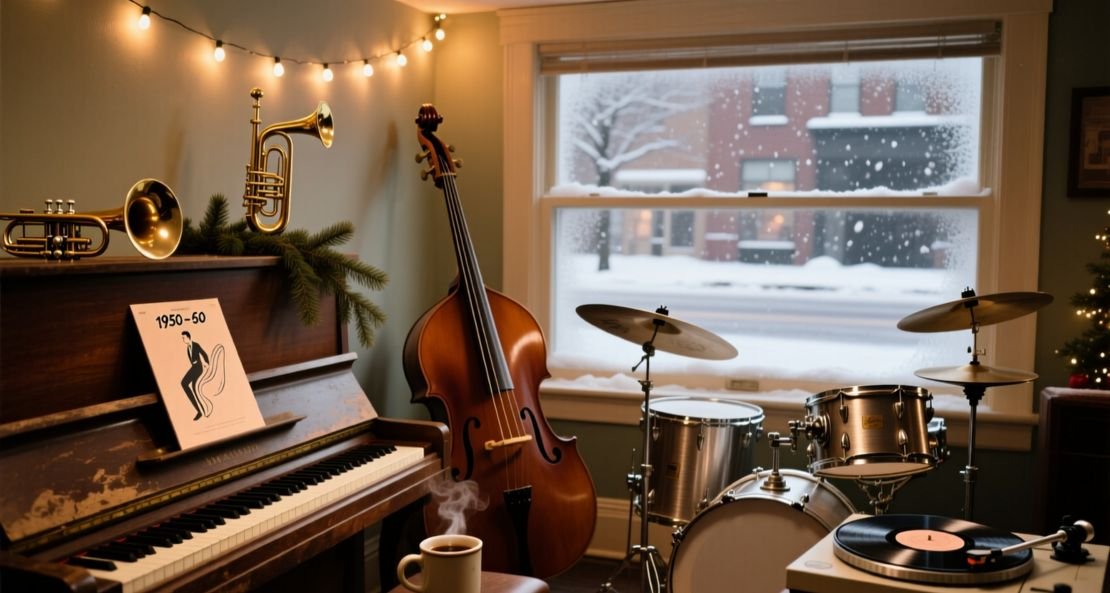
The tinkling piano, the soft brush of cymbals, the warm glow of a trumpet solo cutting through a winter evening. Christmas jazz doesn’t just soundtrack the holidays – it transforms them.
These songs didn’t start their lives in smoky jazz clubs, though. Most emerged from Broadway stages and Hollywood soundstages, crafted by Tin Pan Alley songwriters who probably never imagined their tunes would swing quite this hard.
The connection between Christmas songs and jazz runs deeper than you might expect.
Many secular holiday classics share the same DNA as jazz standards: the 32-bar AABA song form that dominated American popular music from the 1920s through the 1950s.
This structure – eight bars of melody (A), eight more bars of the same melody (A), eight bars of contrasting bridge section (B), then eight bars returning to the original melody (A) – gave jazz musicians exactly what they craved.
Predictable form, rich chord progressions, and plenty of space to improvise.
Think about “Santa Claus Is Comin’ to Town” or “Rudolph the Red-Nosed Reindeer”. These songs follow the same architecture as “I Got Rhythm” or “All The Things You Are”.
George Gershwin, Irving Berlin, and Cole Porter built their empires on this formula, and when Hollywood needed Christmas songs for films like Holiday Inn and Meet Me in St. Louis, they turned to the same blueprint. Jazz musicians simply recognised kindred spirits.
Why Jazz Feels Like Christmas
There’s something about jazz that mirrors the season itself. The harmonic sophistication matches winter’s complexity – those bittersweet chords reflecting how Christmas stirs both joy and melancholy.
The tempos slow down, matching shorter days and longer nights. Brush strokes on cymbals sound like falling snow. A muted trumpet captures the hush of Christmas morning.
Jazz also trades in nostalgia, and Christmas runs on it. We’re constantly trying to recreate some idealised version of holidays past.
Jazz musicians do the same with standards, reinterpreting familiar melodies while searching for something new within the old.
Both Christmas and jazz ask us to honour tradition without becoming trapped by it. Both offer warmth when the world turns cold.
The Classics That Defined Christmas Jazz
“Christmas in New Orleans” – Louis Armstrong (1955)
Louis Armstrong recorded this gem in the summer of 1955, and it remains the most jazz-authentic Christmas song ever written.
Composers Richard M. Sherman and Joe Van Winkle penned it on a hot California day, dreaming of cooler December nights and Dixieland beats.
Sherman, who would later write Disney classics like “It’s a Small World”, created the song as a jazz fan’s love letter to New Orleans.
Neither Sherman nor Van Winkle expected much from their little tune. Then bassist Harry Goodman took it to a recording session.
The next time Sherman heard it, Satchmo himself was laying down vocals, backed by his All Stars.
Armstrong’s gravelly voice transforms lines like “magnolia trees at night, sparkling bright” and “a Dixieland Santa Claus leading the band” into something magical.
The song captures New Orleans Christmas spirit without needing a single snowflake.
The recording, produced by Benny Carter, swings with that characteristic Armstrong warmth. It’s become the template for how to jazz-ify Christmas without losing the holiday’s heart.
James Andrews covered it for A New Orleans Christmas in 1997, keeping the tradition alive for a new generation.
“Christmas Time Is Here” – Vince Guaraldi Trio (1965)
When CBS commissioned a Peanuts Christmas special in 1965, producer Lee Mendelson needed music that would feel different.
He found it in Vince Guaraldi, a San Francisco pianist whose “Cast Your Fate to the Wind” had won a Grammy. Guaraldi initially wrote “Christmas Time Is Here” as an instrumental.
Mendelson scribbled down lyrics during a late-night session, capturing the season’s essence in simple phrases.
The recording sessions took place in autumn 1965 at Fantasy Studios. Guaraldi brought in the children’s choir from St. Paul’s Episcopal Church in San Rafael.
The children got £5 per session, no royalties, and their names didn’t even make the credits. They recorded late into the evening, then went home with ice cream and memories.
The song’s genius lies in its structure. Written in F major with an AABA form, it shifts to D-flat major during the bridge, creating that wistful, melancholic feel that defines Charlie Brown.
The waltz tempo adds elegance. Drummer Jerry Granelli later remarked, “Vince always wanted to write a standard. So he made it.”
Diana Krall, Tony Bennett, Tori Kelly, and dozens of others have covered it since. The song took decades to reach mainstream Christmas consciousness, but now it’s as essential as mistletoe.
“The Christmas Song” – Nat King Cole (1946-1961)
Everyone knows “chestnuts roasting on an open fire”. Nat King Cole first recorded it in June 1946 with his trio, though Capitol Records initially resisted his vision for a lush string arrangement. Cole persisted.
His 1961 stereophonic version, arranged by Ralph Carmichael, became the definitive recording. That version re-entered the Billboard Hot 100’s top 10 in 2023, proving its timeless appeal.
Cole’s vocal approach – smooth, warm, conversational – set the standard for how to deliver Christmas sentiment without drowning in syrup.
The lyrics paint vivid scenes: “folks dressed up like Eskimos,” “tiny tots with their eyes all aglow,” “turkey and some mistletoe”.
Each line evokes nostalgia without specifying which Christmas you’re remembering. That’s the brilliance. Every listener fills in their own details.
The song’s message “Merry Christmas to you” addresses “kids from one to ninety-two”, acknowledging that Christmas spirit transcends age.
Jazz musicians love it because the melody line allows for subtle embellishment without disrupting the narrative. It’s become one of the most-covered Christmas songs in any genre.
“Frosty the Snowman” – Ella Fitzgerald (1960)
When Ella Fitzgerald recorded Ella Wishes You A Swinging Christmas in summer 1960, she brought her signature playfulness to every track. Frank DeVol’s orchestra provided West Coast swing arrangements that matched her energy.
Her interpretation doesn’t reinvent the song so much as reveal its hidden potential. Where other versions lean towards children’s entertainment, Fitzgerald finds genuine joy in lines like “he began to dance around”. The arrangement swings hard without overwhelming her vocals.
Rolling Stone ranked the album at number 10 on its 25 Greatest Christmas Albums list. The Guardian placed it second on their 20 Greatest Holiday Albums Ever.
Nearly 65 years after its release, the album continues introducing new generations to jazz through Christmas music. Fitzgerald made jazz accessible without diluting it.
“Sleigh Ride” – Ella Fitzgerald (1960)
Same album, different energy. “Sleigh Ride” gallops with orchestral flair, Fitzgerald’s voice riding the arrangement like she’s actually racing through snow.
The song, originally composed by Leroy Anderson in 1948, wasn’t written as a Christmas song at all. Anderson created it as a summer piece evoking winter nostalgia. Jazz musicians recognised its potential immediately.
Fitzgerald’s version captures the song’s inherent drama. The horns punctuate key moments, the rhythm section propels the sleigh forward, and Fitzgerald sounds genuinely delighted.
Her phrasing on “just hear those sleigh bells jingle-ing” adds subtle swing that transforms the melody. This is how you take a classical-leaning composition and make it jazz without apology.
“Winter Wonderland” – Multiple Artists
Guy Lombardo’s 1934 rendition established “Winter Wonderland” as a holiday staple, but jazz musicians have owned it ever since. The song works perfectly for improvisation.
Its AABA structure offers clear sections for solos, and the winter imagery doesn’t specify Christmas, giving it broader seasonal appeal.
Louis Armstrong recorded a relatively straight version in the 1950s, letting his tone do the talking. The Eurythmics brought new wave energy to their 1987 version, which charted successfully.
More recently, Laufey’s 2023 cover reached the highest positions on Canadian, Irish, and UK charts, proving younger audiences still respond to quality jazz arrangements.
The song’s opening lines – “sleigh bells ring, are you listening? In the lane, snow is glistening” – establish mood immediately.
The bridge about building a snowman and pretending he’s Parson Brown adds playful romance. Every generation finds something different in these verses, which explains the song’s 90-year run as a Christmas favourite.
“Have Yourself a Merry Little Christmas” – Multiple Artists
Written for Meet Me in St. Louis (1944), this song started life considerably darker. Judy Garland’s original version included lines like “Have yourself a merry little Christmas, it may be your last”.
Frank Sinatra requested cheerier lyrics for his 1957 recording, and we got the version most people know today: “Let your heart be light, from now on our troubles will be out of sight”.
Jazz musicians gravitate towards the song’s inherent melancholy. Even with revised lyrics, there’s sadness lurking beneath the cheer. The melody line allows for rubato phrasing and dynamic variation.
Ella Fitzgerald’s 1960 version demonstrates perfect control, building emotion without manipulation. The song’s AABA structure gives soloists space to explore those bittersweet feelings.
The genius lies in addressing listeners directly: “Through the years we all will be together, if the fates allow”. That conditional “if the fates allow” acknowledges life’s uncertainty.
It’s Christmas realism wrapped in a pretty melody, and jazz musicians excel at expressing complex emotions through simple songs.
“Santa Claus Is Comin’ to Town” – Multiple Artists
Fred Coots and Haven Gillespie wrote this song in 1934, and Eddie Cantor introduced it on radio that same year.
The immediate popularity came from its clever premise: Santa keeps a list and checks it twice. You’d better behave because surveillance is real, even at the North Pole.
Jazz arrangements tend to emphasise the song’s rhythmic drive. The repeated phrases “better watch out, better not cry” create natural call-and-response opportunities.
Big bands love the song because it allows for horn section hits on the title phrase. Ella Fitzgerald’s 1960 version swings effortlessly, her voice playful on “he knows when you’ve been bad or good”.
The song’s continued relevance – it inspired a 1970 animated special and countless covers – stems from its simple message delivered with infectious energy.
Children understand the bargain: good behaviour equals presents. Adults appreciate the craftsmanship. Jazz musicians enjoy the solid chord changes and memorable hook.
“Rudolph the Red-Nosed Reindeer” – Multiple Artists
Robert L. May created Rudolph for a 1939 Montgomery Ward booklet, but Johnny Marks wrote the song that made the reindeer famous in 1949.
Gene Autry’s recording sold millions, and Rankin/Bass Productions turned it into the 1964 television special that defined Christmas for generations.
The song’s narrative arc – rejection, then redemption through unique talents – resonates with misfits everywhere. Jazz musicians, historically outsiders themselves, connect with Rudolph’s story.
The melody allows for both straight readings and heavily swung interpretations. Ella Fitzgerald brings warmth to her 1960 version, emphasising the happy ending: “Rudolph the red-nosed reindeer, you’ll go down in history”.
The television special featured Burl Ives as narrator Sam the Snowman, adding folk music elements to the jazz tradition. This cross-pollination between genres helped Christmas jazz reach broader audiences. Rudolph became jazz’s gateway drug.
“White Christmas” – Multiple Artists
Irving Berlin wrote “White Christmas” for Holiday Inn (1942), and Bing Crosby’s recording became the best-selling single of all time.
Berlin, a Russian Jewish immigrant, penned perhaps the most quintessentially American Christmas song ever. The longing for an idealised Christmas past resonates across cultures.
Louis Armstrong recorded a relatively mainstream version in 1952 with Gordon Jenkins’ Orchestra, aiming for heartland appeal. Yet Satchmo’s cool personality shines through regardless of arrangement.
The song’s ABAC structure (A melody, B melody, A return, C conclusion) gives it slightly different architecture than standard AABA, but jazz musicians adapted easily.
What makes the song jazz-friendly? The chromatic chord movements and the space in the melody for embellishment.
Great singers don’t need to change much – the song’s inherent sadness (“just like the ones I used to know”) provides emotional depth without overworking the lyrics. Sometimes less swing means more feeling.
“Let It Snow! Let It Snow! Let It Snow!” – Multiple Artists
Jule Styne and Sammy Cahn wrote this in 1945 during a California heat wave, dreaming of cooler weather. Like “Sleigh Ride”, it’s not explicitly about Christmas.
The lyrics mention fire, popcorn, and companionship while outside weather frightens. It’s winter romance, pure and simple.
Jazz arrangements typically accelerate the tempo, transforming wistful winter wishes into celebratory exuberance. Ella Fitzgerald’s 1960 version finds the sweet spot between energy and elegance.
Her phrasing on “the fire is slowly dying” adds drama, while “so if you really hold me tight” delivers genuine warmth.
The song’s bridge – “when we finally kiss goodnight, how I’ll hate going out in the storm” – centres romantic intimacy. This adult perspective distinguishes it from children’s Christmas fare.
Jazz musicians appreciate songs that acknowledge grown-up emotions: desire, contentment, the bittersweet nature of temporary happiness.
You might also like:
- Nat King Cole’s The Christmas Song: A Timeless Treasure
- Eartha Kitt’s Santa Baby: A Timeless Classic with a Twist
- Unwrapping Laufey’s Santa Baby: Bill Murray’s Festive Cameo, Jazz Vibes, and Ballet Twists
- V ‘Winter Ahead’ (with Park Hyo Shin): A Cosy Jazz-Pop Anthem for the Season
- 25 Modern Jazz Artists You Need to Hear in 2023
- The History and Evolution of Jazz Music
Modern Voices Carrying the Tradition
Laufey’s Gen Z Jazz Revival
Icelandic singer Laufey has become the unlikely standard-bearer for Christmas jazz among younger audiences.
Her 2023 cover of “Winter Wonderland” achieved record-breaking chart positions internationally. More significantly, her A Very Laufey Holiday collection builds each year, adding new recordings that honour tradition while feeling completely contemporary.
Her 2024 “Santa Baby” video features Bill Murray narrating and American Ballet Theatre principal dancer Isabella Boylston performing choreography by Alex Wong.
That combination – jazz vocals, Hollywood royalty, classical ballet, modern production values – represents Christmas jazz’s evolution.
Laufey’s not imitating Ella Fitzgerald. She’s channelling that same spirit of making jazz approachable without condescension.
Her approach to Christmas jazz mirrors her general aesthetic: vintage sounds through contemporary sensibilities.
She understands the 32-bar AABA form, respects the Great American Songbook tradition, and delivers it with a Gen Z twist. The jazz world needs ambassadors like this.
V’s “Winter Ahead (with Park Hyo Shin)”
BTS member V released this jazz-pop gem in November 2024, collaborating with Korean ballad legend Park Hyo Shin.
The production features Grammy-winning songwriter Jesse Harris (who wrote Norah Jones’ “Don’t Know Why”), alongside HYESUNG and Waizmin.
The track layers delicate piano melodies, stirring strings, and warm brass in arrangements that feel both intimate and expansive.
V’s love for jazz runs through his solo career, from debut album Layover to holiday hits like “Snow Flower” and “Christmas Tree”. “Winter Ahead” deepens this exploration, bringing K-pop audiences into jazz territory.
The song doesn’t follow typical Christmas song structure, instead offering something more contemplative. It’s winter music rather than Christmas music, which gives it broader appeal.
The chemistry between V and Park Hyo Shin adds emotional weight. Their voices complement rather than compete, creating harmonies that feel lived-in and genuine.
This represents Christmas jazz’s global future – artists from different traditions finding common ground in quality musicianship.
Michael Bublé’s Holiday Dominance
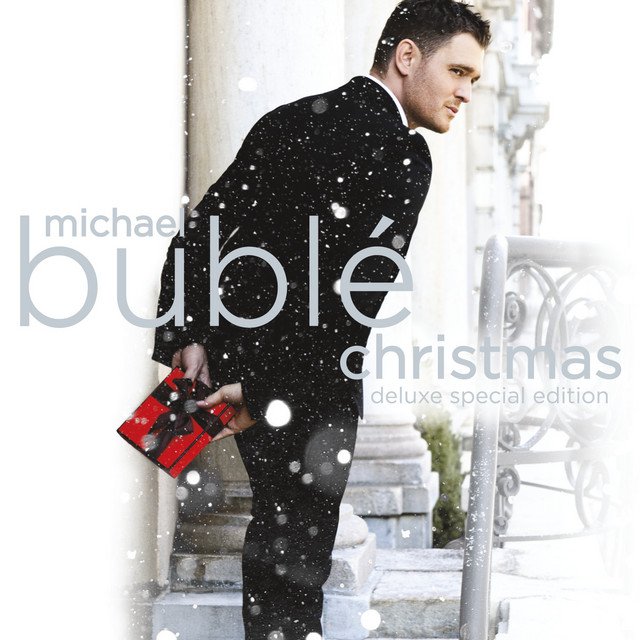
No discussion of modern Christmas jazz feels complete without acknowledging Michael Bublé’s Christmas (2011), which has sold over 18 million copies worldwide.
His approach marries classic big band arrangements with contemporary production values, making Sinatra-era swing accessible to streaming audiences.
Bublé’s covers of “It’s Beginning to Look a Lot Like Christmas,” “Holly Jolly Christmas,” and “Jingle Bells” demonstrate technical mastery without showboating.
His voice carries the warmth these songs require, and his arrangements respect the originals while adding subtle modern touches.
The album’s success proved Christmas jazz could still dominate charts in the streaming era.
His original composition “Christmas (Baby Please Come Home)” blends Motown energy with jazz sensibility, showing he understands the genre beyond mere recreation.
Bublé makes Christmas jazz feel current, not nostalgic – a crucial distinction for reaching younger listeners.
Norah Jones’ Intimate Approach
Norah Jones brought her signature understated elegance to Christmas music, recording versions that strip away orchestral bombast.
Her 2021 cover of “Christmas Time Is Here” honours Guaraldi’s original while adding her own jazz-folk hybrid sensibility. The piano arrangement stays minimal, letting her smoky vocals carry the emotional weight.
Jones recorded “The Christmas Song” as part of various compilation projects, approaching it with the same restraint that made “Don’t Know Why” a phenomenon.
She doesn’t oversing or overarrange. That restraint feels revolutionary in an era when Christmas music tends towards maximalism.
Her style proves Christmas jazz doesn’t require big band production. Sometimes a piano, bass, drums, and honest vocals deliver more impact than full orchestration. Jones reminds us that intimacy scales better than grandeur.
Jacob Collier’s Harmonic Revolution
Jacob Collier represents Christmas jazz’s experimental future. His multi-tracked arrangements of traditional carols push harmonic boundaries while maintaining the songs’ emotional cores.
When Collier tackles “In the Bleak Midwinter” or creates his own Christmas compositions, he brings micro-tonal inflections and jazz reharmonisations that would make Vince Guaraldi proud.
His 2020 collaboration with Jessie Reyez on “Christmas in L.A.” blends jazz chord progressions with contemporary R&B production.
The song captures Christmas in warmer climates, expanding beyond the winter wonderland narrative that dominates the genre.
Collier’s approach shows how jazz harmony can infiltrate pop structures without losing accessibility.
For music theory enthusiasts and casual listeners alike, Collier demonstrates that Christmas jazz can still evolve. His arrangements reward close listening while remaining emotionally direct – the balance every great Christmas song needs.
The Continuing Evolution
Other contemporary artists expanding Christmas jazz include Darius de Haas (bringing theatrical sensibility), Lakecia Benjamin (soul-jazz fusion), Jake Shimabukuro (ukulele jazz), and Stella Cole (vintage meets modern).
Each artist approaches the tradition differently, yet they all respect the fundamentals: solid arrangements, space for improvisation, emotional honesty.
Streaming data shows holiday music consumption starting earlier each year, sometimes beginning in October.
This extended season gives Christmas jazz more opportunities to reach listeners who might otherwise stick with pop hits.
The genre’s versatility – working equally well as background music or active listening – positions it perfectly for various holiday contexts.
Why These Songs Endure
Christmas jazz songs succeed because they balance familiarity with sophistication. The melodies stick after one listen, yet the arrangements reveal new details with repeated exposure.
A child enjoys “Rudolph the Red-Nosed Reindeer” while an adult appreciates the trumpet solo’s harmonic choices.
The 32-bar AABA structure that dominates these songs creates satisfying symmetry. Listeners subconsciously recognise the pattern, which provides comfort.
The bridge offers variation before returning to familiar territory. This formula works whether you’re writing for Broadway, recording a jazz standard, or composing a Christmas classic.
These songs avoid religious specificity while maintaining spiritual warmth. They celebrate winter, family, generosity, hope – universal values that transcend particular faiths. This secular approach made them perfect for jazz musicians from all backgrounds.
The best Christmas jazz songs capture something genuine about the season: its mixture of joy and melancholy, the pressure to feel cheerful, the genuine moments of connection that make the chaos worthwhile.
Louis Armstrong understood this. Ella Fitzgerald felt it. Vince Guaraldi expressed it perfectly.
Jazz musicians will keep reinterpreting these songs for decades to come. Each new version adds another layer to our collective understanding.
Christmas jazz isn’t stuck in the past – it’s a living tradition that welcomes fresh perspectives while honouring what came before.