
Release: Song from The Life of a Showgirl (October 2025) | Music video premiered February 6, 2026 (Spotify/Apple Music), February 8, 2026 (YouTube)
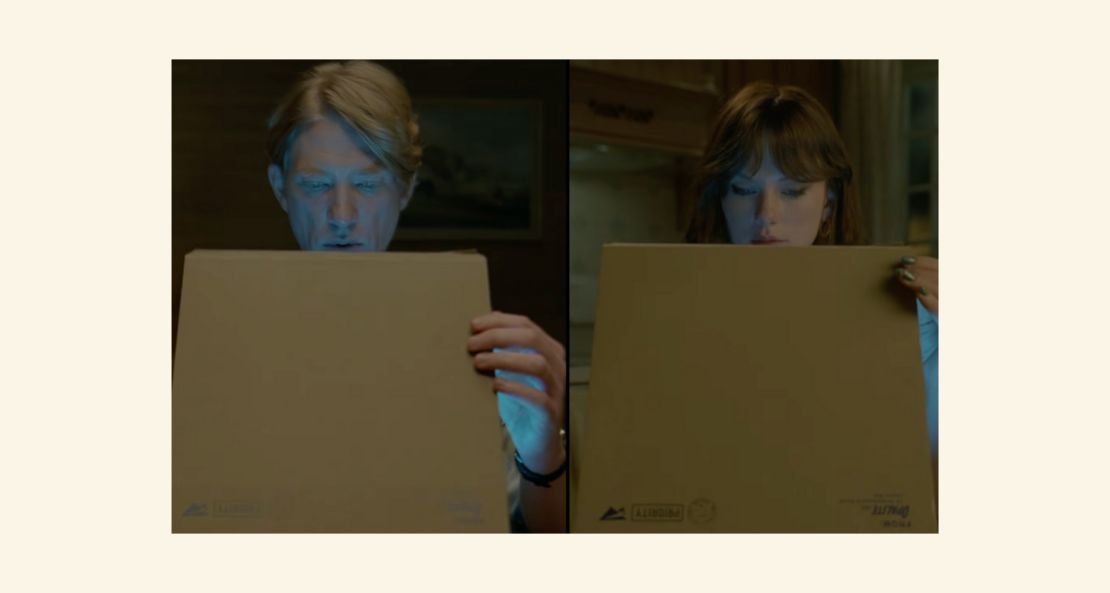
The most revealing moment in Taylor Swift’s “Opalite” video arrives when Domhnall Gleeson’s character discovers his cactus has transformed into a sentient partner, and rather than questioning the logic, he simply accepts it.
That choice to abandon narrative coherence for pure aesthetic pleasure marks the cleanest break Swift has made from her own mythology in years.
“Opalite” isn’t a puzzle to decode. It’s Swift testing what happens when spectacle replaces symbolism.
What feels different here is the absence of control. The video originated from a spontaneous idea during Swift’s October 2025 appearance on The Graham Norton Show, when Gleeson jokingly expressed interest in appearing in one of her videos.
Soon after that couch conversation, Swift moved fast enough to turn a joke into a full concept, recruiting Cillian Murphy, Lewis Capaldi, Greta Lee, Jodie Turner-Smith, plus host Graham Norton.
This improvisation shows. The casting feels less like Easter-egg architecture and more like genuine collaborative play.
Shot on film by Rodrigo Prieto, the cinematographer behind Killers of the Flower Moon and Barbie, the video leans into a deliberately degraded VHS aesthetic.
“Opalite” commits entirely to its 1990s infomercial conceit without apologising for the silliness, opening with a fake advert for a spray that turns emotional stagnation into instant connection.
Swift plays a woman so lonely she’s befriended a pet rock; Gleeson suffers a similarly dysfunctional attachment to a cactus.
When a spray-on solution called Opalite brings them together, the video abandons metaphor for montage: dance competitions, mall dates, arcade games, all presented with the kind of earnest cheese that defined pre-internet romance.
Murphy’s involvement proves particularly telling. An actor notoriously selective about commercial work appears here as both a billboard image and the infomercial’s voiceover, lending his Oppenheimer-era gravitas to lines about transforming “crappiness into happiness.”
The tonal whiplash is intentional. Swift knows exactly how absurd this looks, and that self-awareness liberates the entire project from needing to mean anything beyond what it shows. For once, Swift isn’t building a universe; she’s just playing inside one.
The symbolism stays mostly on the surface, and that feels deliberate. The video reads as if the pet rock stands for emotional distance, while the cactus hints at a love that stings.
When Norton appears hawking “Nope-alite,” a reverse spray promising to undo romantic connection, the joke lands because it refuses to deepen into commentary.
This restraint marks a departure from the layered storytelling of “Fortnight” or the showgirl mythology explored in “The Fate of Ophelia.”
Where those videos demanded analysis, “Opalite” simply asks viewers to enjoy the aesthetic.
Setting the story in the ’90s feels deliberate, like Swift reaching back to a time before romance had to perform for algorithms.
Before dating apps reduced connection to swipes, before social media turned relationships into content, people fell in love through chance encounters at malls and arcades.
Swift’s decision to locate this narrative in that pre-digital space reads less as nostalgia and more as ideological positioning.
The video proposes that genuine connection requires removing layers of contemporary performance, returning to a moment when sincerity wasn’t automatically suspect.
Fans immediately began cataloguing possible references, including posters some believe nod to George Michael’s Father Figure, carnations instead of roses echoing folklore‘s class commentary, a single thread recalling “Invisible String,” and the phrase “f*ck you forever” lifted directly from “Mad Woman.”
But these callbacks function differently here. Rather than constructing an elaborate puzzle, they operate as textural detail, background information that enriches repeat viewings without blocking initial comprehension.
The inclusion of Eras Tour dancers alongside A-list actors collapses the usual hierarchy between Swift’s inner circle and mainstream celebrity.
Everyone occupies the same goofy universe, wearing terrible sweaters and committing fully to the bit. It doesn’t feel like Swift trying to look effortless. It feels like she actually is.
At Neon Music, we read this as Swift loosening her grip. What happens next will determine whether this tonal shift holds or represents a brief exhale before returning to more controlled narratives.
The spontaneity that birthed “Opalite” feels genuinely rare in Swift’s directing catalogue, a moment where the process mattered less than the pleasure.
For an artist whose reputation rests on meticulous planning, allowing chaos to guide creative decisions signals something changing.
Not settling. Not safe. Just different enough to notice the difference.
You might also like:
- Taylor Swift’s “Opalite” Meaning and Review
- Taylor Swift’s Fortnight: What the Lyrics and Video Really Mean
- Taylor Swift’s All Too Well Lyrics, Meaning & The 10-Minute Short Film Explained
- Taylor Swift’s Enchanted Lyrics Unpacked: A Glimpse Into What Was Never Said
- Addison Rae High Fashion Lyrics Meaning & Music Video Analysis
- JADE “Church” Review: Music Video & Lyrics Analysis